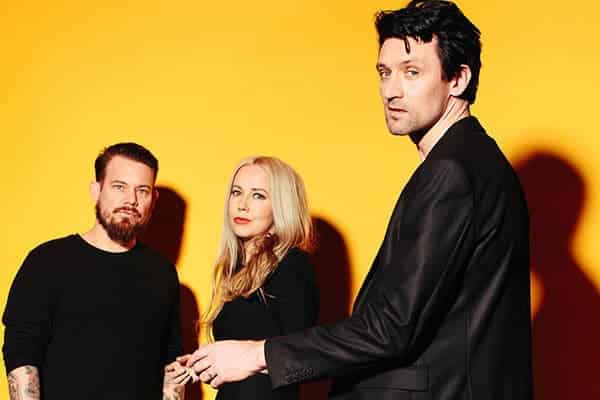
Something for Kate is back for their first national tour in five years, promoting their new album Leave Your Soul To Science. It’s been six years since the band produced their last album, and fans have been eagerly anticipating the release ever since.
It was back in 1996 that Murmur Records signed the three-piece. Paul, Steph and Clint have since toured endlessly throughout Australia and internationally, sharing stages with everyone from David Bowie to Death Cab for Cutie. Along the way they’ve collected 13 ARIA nominations, four Top 10 albums and numerous awards for Best Live Band, Best Album and Best Single from Rolling Stone Magazine, Triple J, The Age and the Australian Music Industry Critics Awards — just to name a few.
They have certainly left their fans wanting more, and are hoping to meet those expectations with their newest record. GCMag caught up with Steph to find out what the band has been up to and get a better insight into what we can expect.
One word of advice before you listen — get yourself some decent speakers. This record on a laptop won’t do it any justice, and the bass player will be more than a little miffed!
The name of the new album, Leave Your Soul To Science, has an eerily sterile yet emotional feel to it. Was that what you were aiming for?
Well, I hadn’t thought of the word sterile — but I think what we were really going for was being a bit cheeky! There’s a lot of talk about people leaving parts of their bodies to science for the furthering of medicine and mankind, but there’s also a lot of talk about the soul and things being soulless. Everyone feels that they have a soul, and what we’re saying is — if you have one, let’s see it. Let’s dissect it.
This is your sixth album in 14 years, and listening to it you can tell you’ve evolved into a sound vastly different from previous records. What prompted this desire to experiment?
I think just sanity and life. A lot of people talk about the first album and desperately want everything to sound like it — but you can’t replicate your early work, and you don’t want to. It’s natural evolution. The book you write as an author at 20 would be very different from the one you write at 30. It’s just an extension of the idea that people change and want to explore new things. You don’t want to get stagnant.
There’s such an immense array of emotions touched on throughout the album. Were you aiming for such a broad spectrum when you began working on it?
Absolutely. Think of how many things you go through in just one day — and this record was written over two years, much of it while we were living in New York. During that period a lot was happening in America: the recession, the social fallout from that, and a lot politically as well. You go through a lot emotionally in that time, so there are definitely songs about all sorts of different things on this record.
Paul has described the album as “organised chaos.” Is it chaotic because of all the different themes within it?
Paul doesn’t like to pin down lyrics to one exact meaning — he has his own meaning and doesn’t want to enforce that upon the listener. So we’re always a little hesitant to say exactly what things are about.
You’ve been spending a lot of time in New York and spent the majority of the past two years working on the album there. What did you enjoy most about your time over there?
We’ve been spending a lot of time in New York for the last decade, to the point where we just decided to move there. It’s just everything — a place where we feel at home culturally, socially, and creatively. Politically it’s still very dicey, but I think when you’re a musician, living in New York is a really great thing.
What has been your main source of inspiration for the new album?
Probably everything I was just talking about. Living in another country, experiencing different things. There’s a lot rooted in the social fallout from political events — the Wall Street situation had a big impact on everybody. Paul was really interested in exploring that from the perspective of how it affected people’s relationships. There’s a character in one of the songs who is a hedge fund kid genius who lost everything in the recession and has realised he can no longer pick up women with that line — because being in finance has become deeply unfashionable.
The track Back to Normal really resonated with me — so raw and carnal. When you put the album together, were you hoping fans would connect with the music at that kind of emotional level?
Absolutely. Lyrically there are some really potent images in that song that stick with me, and I hope they stick with others. I think of that song and I think of this woman with a gun in her bathrobe — these almost cinematic domestic scenes, but really about emotional and mental violence that goes on in relationships behind closed doors that you never see. We tried to use the music to push those buttons and create as raw a connection as possible between the music and the lyrics.
Your fans have sorely missed you — evident in how quickly your shows are selling out. What are you most looking forward to on the upcoming tour?
I like the idea of people knowing the new songs before we play them, so it’s a little strange going on tour just a week after the record comes out. I would have preferred to wait so people could live with the album first and then experience those songs live. But hopefully people will come in with a fresh relationship with the record, and I’m really looking forward to seeing how they respond to the new songs.
Welcome back — we’ve missed you. It sounds divine!
I’m so glad you liked it. Our records take a few listens. People hear a song once or twice and go “huh?” — and that’s kind of by design. We’re not really a one-listen band. Our songs reward attention; they reveal something more profound the more you listen, the more you put the images together with the subtext of the lyrics and the music. That doesn’t always happen on the first listen. You always hope people will give them some time, live with them a little, and allow them to sink in. Perhaps I’m just a product of my generation — living with records for a long time and buying actual CDs.
That opens up an interesting topic — do you feel that social media, YouTube and iTunes have cheapened the way people listen to music?
It’s hard to say, because the relationship with music is such a subjective one. From a musician’s perspective though, it saddens me that people listen to music on their laptops. I think it’s an aural medium — we go through a lot of trouble to make it sound great, and knowing that people are listening to streams on a laptop drives me insane. I play bass! My whole life is about the bottom end, and it’s just not there on that medium.
You used to get a CD, go home, put it on the stereo with great speakers, sit down and read the booklet — the liner notes, everything. Now it’s on iTunes and you can listen to it at work while you’re typing something. All that work that goes into mastering — the frequencies, getting everything perfect — and it’s just lost. A little bit of a bummer.