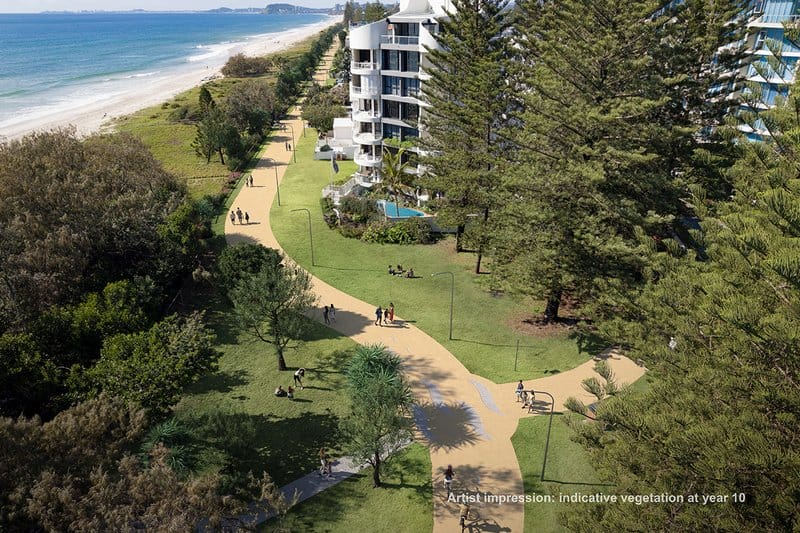

Draft designs for the next stage of the Gold Coast Oceanway have been unveiled, revealing plans for an 850-metre shared pathway linking Pratten Park in Broadbeach to Ocean Street in Mermaid Beach. The project addresses a critical gap in the City of Gold Coast’s long-term plan to deliver a continuous 36-kilometre active transport corridor between Coolangatta and The Spit. The Mermaid Beach North segment represents one of five remaining links in the citywide network.
Council has targeted construction for 2027, with the current 60 per cent design stage scheduled for progression to detailed designs early that year. Coastal survey works are underway, and the required state and federal environmental approval applications have been submitted. Mayor Tom Tate confirmed that public consultation demonstrated strong backing for the active transport link.
"Our recent consultation confirmed the community wants the Oceanway completed, creating a safer, wider shared pathway for pedestrians, cyclists and mobility users to enjoy our beautiful coastline," Mayor Tate said. "That's why we're getting the job done, starting in Mermaid Beach."
Coastal Protection and Path Specifications
The proposed infrastructure features a five-metre-wide concrete path designed to comply with the Disability Discrimination Act 1992. Engineered to withstand coastal erosion, the alignment sits entirely west of the existing underground boulder seawall. This configuration enables standard concrete construction, contrasting with the narrow conditions directly to the south between Ocean Street and Seashell Avenue, where available space between private boundaries and the seawall constricts to 2.5 metres.
To bolster coastal defence during extreme weather events, contractors will reconstruct up to 100 metres of the existing seawall alongside path works. At the southern termination point on Ocean Street, existing on-street parking spaces will be removed to provide a dedicated transition zone. This transition directs cyclists and walkers into Hedges Avenue, which is undergoing conversion into a cycle-priority boulevard following the permanent closure of through traffic in July.
"Together, these projects will improve safety, accessibility and connectivity along one of the Gold Coast’s most popular coastal destinations," Mayor Tate added.
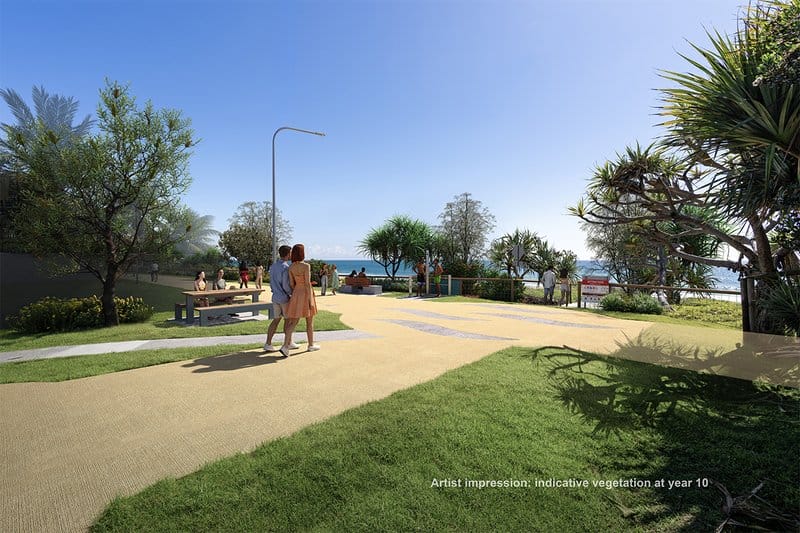
Environmental Safeguards and Street-End Amenities
Environmental management forms a central pillar of the engineering plan. Detailed arborist assessments have established that total replacement plantings will exceed the volume of trees removed during clearing. To prevent planting failure, council arborists advised using smaller nursery stock that adapts successfully to harsh foreshore conditions, allowing a healthy canopy to establish over several years. Supplementary dune revegetation aims to anchor sand profiles and support local beach ecosystems.
Public lighting across the corridor incorporates strict wildlife protection measures. Luminaires mounted on six-metre poles comply with national fauna guidelines to prevent disorienting marine turtles and shorebirds, with illumination dimmed automatically between 10:00 pm and 5:00 am.
"We listened to the community when they told us they wanted the Oceanway delivered with appropriate environmental protections in place," Mayor Tate said.
Public realm upgrades at street ends will modernise local foreshore access. Timber beach decks will be replaced with new picnic tables, bar seating, bench seating, outdoor showers, and bicycle racks. One timber deck will be retained at Ken Mansbridge Park, while the Mermaid Beach volleyball courts will be relocated to an alternative beachfront site to be announced once finalised.