

Digital entertainment has become one of the most data-heavy parts of everyday online life. Streaming platforms track what people watch, gaming platforms record how users play, mobile apps measure engagement, and advertising systems turn preferences into targeting signals.
Online privacy in digital entertainment is about how much control users have over that information. It includes personal details such as names, email addresses and payment information, but it also includes behavioural data: watch history, game choices, device IDs, location signals, in-app purchases, chat activity, session length and advertising interactions.
This matters because entertainment data can reveal more than it seems. A playlist, viewing history or gaming account may expose personal interests, routines, age signals, spending behaviour and sensitive preferences. For users, the challenge is not only whether a platform is fun or convenient. It is whether the platform collects more data than necessary, explains that collection clearly and gives people practical ways to limit it.
As streaming, gaming and online entertainment continue to merge, privacy is becoming part of the user experience. People want fast access and personalised recommendations, but they also want fewer surprises about how their data is used.
Why Privacy Now Matters in Streaming, Gaming and Online Entertainment
Digital entertainment used to be simpler. A person bought a game, rented a movie or watched television without creating a detailed behavioural profile. Today, most entertainment happens through accounts, apps, subscriptions and connected devices.
That shift has made entertainment more convenient, but it has also increased data collection. A streaming service may know what genres a user prefers, when they usually watch, which shows they abandon and which trailers they replay. A gaming platform may know play time, purchases, friends, chat activity, achievements, device details and behavioural patterns.
This data is often used for personalisation. Recommendations, saved progress, parental controls, fraud prevention and account security can all depend on data. Not every form of collection is automatically abusive. Some data use improves the product.
The problem starts when users cannot easily tell what is necessary and what is excessive. A platform may collect data for service delivery, analytics, advertising, content recommendations, fraud detection, product development and third-party partnerships. These purposes are often spread across long privacy policies that few users read carefully.
Digital entertainment also creates a privacy paradox. Users want a smooth experience with fewer barriers, but stronger privacy sometimes requires more friction: account checks, permission prompts, two-factor authentication, age verification, parental settings or privacy dashboards.
This tension is visible across account-based entertainment, including gaming platforms where users often want fewer interruptions but still need clear information about privacy, security and account checks. Guides that compare models such as a no verification casino guide can be useful when they help users understand the trade-off between convenience, verification requirements and data exposure. The key point is not to avoid safeguards, but to understand what information is requested, why it is needed and what risks come with reduced friction.
What Data Entertainment Platforms Collect
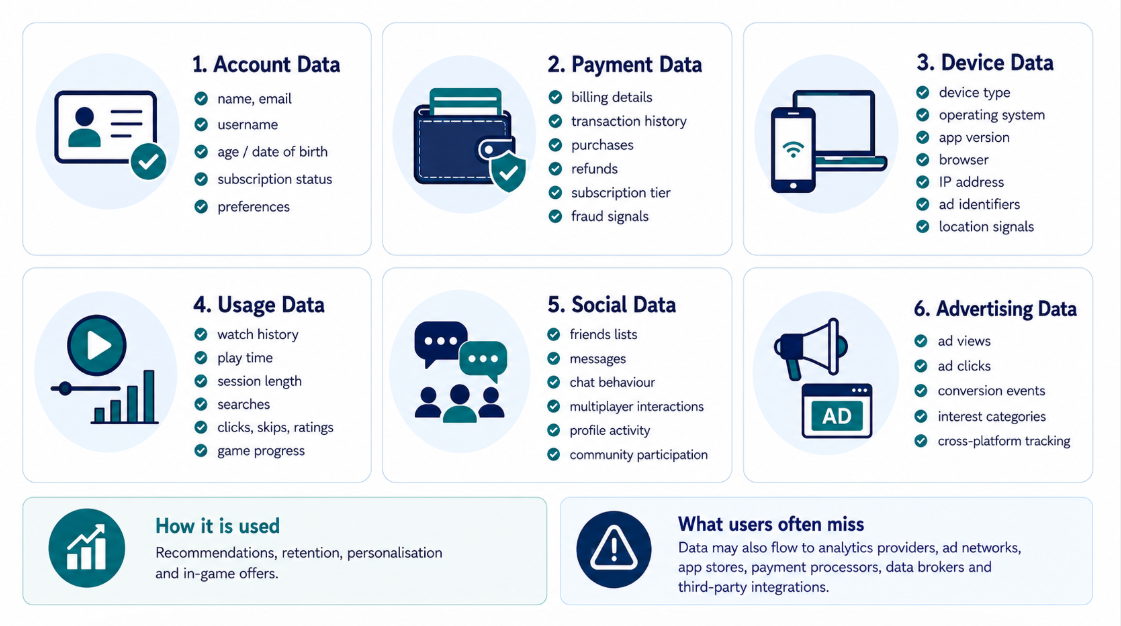
Streaming and gaming platforms collect more than basic account information. The modern entertainment experience is built around signals: what users click, how long they stay, what they buy, what they skip and which devices they use.
Common categories of data include:
- Account data: name, email address, username, password, age or date of birth, subscription status and account preferences.
- Payment data: billing details, transaction history, subscription tier, refunds, purchases and sometimes fraud-related risk signals.
- Device data: device type, operating system, app version, browser, IP address, advertising identifiers and approximate location signals.
- Usage data: watch history, play time, session length, search queries, clicks, pauses, skips, ratings and game progress.
- Social data: friends lists, messages, chat behaviour, multiplayer interactions, profile activity and community participation.
- Advertising data: ad views, ad clicks, conversion events, interest categories and cross-platform tracking signals.
Streaming services often use this information to recommend content and reduce churn. If a platform knows a user likes true crime documentaries, live sport, anime or reality TV, it can push similar content. That can feel useful, but it also means entertainment preferences become part of a profile.
Gaming platforms often collect even richer behaviour. A game may track how a player moves through levels, how often they return, which purchases they make, when they stop playing and what incentives bring them back. In free-to-play or mobile environments, this data can shape offers, reminders and in-game design.
The risk is not only that platforms collect data. The risk is that users often do not understand the full chain: platform collection, analytics providers, ad networks, app stores, payment processors, data brokers and third-party integrations. Entertainment can feel casual, but the data ecosystem behind it is often complex.
How Tracking, Advertising and Personalisation Work
Personalisation is one of the main reasons digital entertainment platforms collect so much data. Recommendations, playlists, “continue watching” rows, suggested games, friend recommendations and targeted offers all depend on tracking user behaviour.
At a basic level, a platform observes what a user does. It may record that someone watches action movies, plays late at night, buys expansion packs, clicks on sports content or abandons a show after ten minutes. Over time, these signals become a profile.
That profile can be used for content recommendations, product decisions, retention campaigns, advertising, pricing tests and promotional offers. A streaming service may use the profile to recommend a new series. A gaming platform may use it to suggest a title, send a push notification or present a limited-time incentive.
Personalisation is not automatically negative. Many users like recommendations that save time. A gaming platform that remembers progress or a streaming service that surfaces relevant shows can improve the experience.
The privacy concern is that personalisation can become invisible persuasion. If platforms know what keeps users watching, playing or spending, they can design experiences that encourage longer sessions and more frequent engagement. In gaming, this can include timed rewards, limited offers, notifications and personalised promotions.
Another problem is design. Privacy controls are often technically available, but they may be buried behind several menus, written in vague language or presented after a large “accept all” button. This does not always happen by accident. The easier path is often the one that gives the platform more data, while the privacy-friendly path requires more time, more clicks and more understanding from the user.
Microtargeting can also expose sensitive patterns. A user may not think that entertainment choices are personal, but preferences can reveal political interests, cultural identity, health concerns, age signals, family status, sexuality, religion, mood or financial behaviour depending on the content involved.
This is why privacy settings should not be treated as technical details. They are part of how much control a user has over the experience. A platform that makes tracking easy to understand and easy to limit gives users more agency than one that hides everything behind vague policy language.
Where Privacy Risks Become Real
Privacy risk becomes real when entertainment data is exposed, misused, over-collected or combined with other information in ways users did not expect.
Data breaches are the most obvious risk. If a gaming or streaming account is breached, attackers may gain access to email addresses, usernames, passwords, purchase history, payment-related details, saved addresses, chat logs or linked accounts. Even when full card numbers are not exposed, the leaked data can still be useful for phishing or identity fraud.
Account takeover is another common issue. If a user reuses passwords across services, a breach on one platform can lead to attacks on other accounts. Gaming accounts may also have digital items, stored value, friends lists or payment methods attached, which can make them attractive targets.
There is also the issue of sensitive preferences. Entertainment history can reveal personal interests that users may not want shared with employers, family members, advertisers or unknown third parties. A watchlist, gaming profile or community history can say more about a person than they realise.
Weak privacy policies add to the problem. Many policies are long, legalistic and difficult to compare. They may technically disclose data use while failing to explain it in plain language. A user may agree to data sharing without understanding who receives the data, how long it is kept or whether it is used for advertising.
Platform consolidation can reduce user choice. When a few large companies control streaming libraries, game stores, social layers, payment systems and advertising networks, users may have fewer realistic alternatives. Leaving one service may not mean escaping the same broader tracking ecosystem.
Privacy risk also grows when entertainment platforms are used by children and teenagers. Younger users may not understand how profiles are built or how in-app activity can shape recommendations, ads and engagement loops. That is why child privacy and age-appropriate design are becoming more important in policy discussions.
Why Account Checks and User Convenience Are in Tension
One of the hardest privacy questions in digital entertainment is how much friction is acceptable. Users want quick sign-ups, instant access and fewer repeated checks. Platforms need to prevent fraud, meet legal obligations and protect accounts.
This creates tension. A streaming service may ask for payment verification. A gaming platform may require age checks, two-factor authentication or account recovery details. A marketplace may need identity checks to prevent abuse. A regulated entertainment product may need stronger account controls than a casual app.
From the user’s perspective, these checks can feel annoying. From the platform’s perspective, they may be necessary for safety, compliance or fraud prevention.
The problem is not verification itself. The problem is unnecessary or poorly explained data collection. Users are more likely to trust a platform when it explains:
- what information is required;
- why the information is needed;
- how long it will be kept;
- who it may be shared with;
- what privacy controls are available;
- how users can delete, correct or access their data.
Better privacy design does not always mean removing checks. Sometimes it means making checks proportionate, transparent and easier to understand. A platform should not ask for more information than it needs, but it should also avoid pretending that privacy means no accountability.
For users, the practical rule is simple: less friction is convenient, but it should not replace due diligence. If a platform avoids explaining its data practices, hides ownership details or makes privacy controls difficult to find, that is a warning sign.
Tools and Habits That Improve Privacy
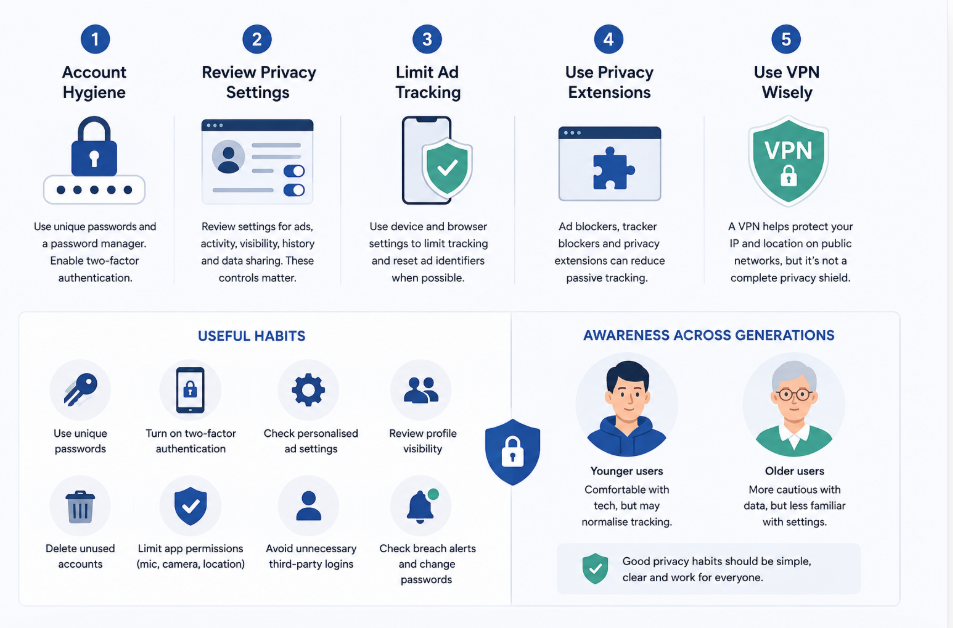
Users cannot control every part of the entertainment data ecosystem, but they can reduce exposure with better habits and privacy tools.
The first step is account hygiene. Entertainment accounts should not use recycled passwords. A password manager can help create unique passwords for streaming, gaming, app stores and payment accounts. Two-factor authentication should be enabled wherever possible, especially for gaming accounts with purchases, stored value or social features.
Second, users should review privacy settings inside each platform. Many services offer controls for personalised ads, activity visibility, watch history, friend discovery, voice chat, profile visibility and data sharing. These settings are often buried, but they matter.
Third, users can limit ad tracking. On mobile devices, operating systems usually provide options to restrict app tracking or reset advertising identifiers. Browsers may allow users to block third-party cookies, limit fingerprinting or clear site data.
Fourth, browser privacy extensions can reduce tracking on entertainment websites. Ad blockers, tracker blockers and privacy-focused browsers can limit some third-party scripts. They are not perfect, but they can reduce passive data collection.
Fifth, a VPN can help reduce exposure of IP-based location signals and improve privacy on untrusted networks. However, a VPN is not a magic privacy shield. It does not stop a logged-in platform from tracking activity inside the account, and it does not fix weak passwords or poor privacy settings.
Useful habits include:
- using unique passwords for every entertainment account;
- turning on two-factor authentication;
- checking personalised ad settings;
- reviewing profile visibility and social sharing;
- deleting unused accounts;
- limiting permissions for microphone, camera and location;
- avoiding account sign-ups through unnecessary third-party logins;
- checking breach alerts and changing passwords quickly after incidents.
Privacy awareness also differs across generations. Younger users may be more comfortable with digital accounts and in-app settings, but they may also normalise constant tracking. Older users may be more cautious about personal details, but less familiar with app permissions or ad settings. Good privacy habits should be simple enough for both groups.
The Future of Privacy in Digital Entertainment
Privacy in digital entertainment will become more important as platforms collect more behavioural data and users demand more control.
Several trends are already visible. First, users are becoming more aware of tracking. People may still accept personalisation, but they increasingly expect clear settings, simple explanations and meaningful choices.
Second, regulators are paying closer attention to children’s privacy. In Australia, the Office of the Australian Information Commissioner is developing a Children’s Online Privacy Code after the Privacy and Other Legislation Amendment Act 2024. The OAIC says the Code will put children at the centre of privacy protections in Australia and will apply to many online services used by children, including apps, games and websites. Users can read the OAIC’s information on the Children’s Online Privacy Code for the official Australian context.
Third, international frameworks such as COPPA in the United States show that child privacy is not only an Australian issue. Platforms that operate globally often need to think across multiple legal systems, age groups and safety expectations.
Fourth, privacy-enhancing technologies may become more common. These can include better consent dashboards, on-device personalisation, data minimisation, encrypted communications, privacy-preserving analytics and stronger account security tools.
Fifth, platform consolidation will continue to shape user choice. If major entertainment ecosystems combine streaming, gaming, advertising, social features and payments, users may find it harder to separate one part of their digital life from another. That could make privacy controls more important, but also more complex.
The future will not be privacy-free entertainment or fully anonymous entertainment. More likely, it will be a negotiation between convenience, safety, legal compliance and user control. Platforms that explain this clearly will earn more trust than those that hide behind vague terms.
FAQ
What is digital privacy and why does it matter in entertainment?
Digital privacy is the control users have over personal and behavioural data. In entertainment, it matters because viewing, gaming and spending habits can reveal sensitive preferences.
How do streaming services use my viewing data?
Streaming services use viewing data for recommendations, product improvement, retention campaigns and sometimes advertising. Watch history can shape what users see next and how platforms categorise interests.
Are gaming platforms tracking my personal information?
Many gaming platforms track account details, device data, play time, purchases, social activity and behaviour patterns. Some tracking supports security and gameplay, while some supports advertising or engagement.
Can my entertainment preferences be used to target me with ads?
Yes. Entertainment preferences can contribute to advertising profiles, especially when platforms use tracking pixels, app identifiers, cookies, third-party partners or cross-platform analytics.
What happens if my gaming account data is breached?
A breach can expose emails, usernames, passwords, purchase history, chat data or linked accounts. Users may face phishing, identity theft attempts, account takeover or unauthorised purchases.
Conclusion
Online privacy in digital entertainment is no longer a niche technical issue. Streaming services, gaming platforms, mobile apps and connected accounts all collect data that can shape recommendations, advertising, security decisions and user experiences.
The goal is not to reject every form of data collection. Some data helps platforms work properly. The real issue is whether collection is necessary, transparent and controllable.
Users can protect themselves by using stronger account security, reviewing privacy settings, limiting ad tracking, managing permissions and deleting unused accounts. At the same time, platforms need clearer policies, better privacy dashboards and stronger protections for younger users.
Entertainment should be convenient, but convenience should not come at the cost of invisible tracking or unclear data use. The more users understand how privacy works, the better they can choose which platforms deserve their trust.