The polished interior hasn’t disappeared, but there are signs that Australian design is becoming less interested in perfection for its own sake.
Current colour forecasts favour warmth, individuality and imperfection. Recent award-winning houses show architects working with existing buildings, courtyards, landscape and materials that develop character with use. At the same time, Australian households continue to invest heavily in altering and extending existing homes.
None of this proves that every Australian living room is changing in the same direction. It does point to a visible design mood, though: rooms that feel tactile rather than pristine, adaptable rather than fixed, and comfortable with the evidence of everyday life.
Liveability Is Becoming Part of the Design Conversation
Practicality once had a slightly apologetic place in interiors. A family-friendly fabric, easy-care surface or washable floor covering could be treated as the sensible alternative to the piece you really wanted.
That division is becoming harder to justify.
The Australian Bureau of Statistics (ABS) reported that the value of alterations and additions to residential building reached $3.976 billion in the March 2026 quarter in seasonally adjusted chain-volume terms, 4.1% higher than the previous quarter. The ABS cautions that the figures remain subject to revision (Australian Bureau of Statistics, 2026).
The statistic doesn’t reveal why individual projects were commissioned or how the finished homes were furnished. It does, however, indicate continued investment in changing existing residential spaces.
Within interiors, that practical thinking is also influencing product design. Washable rug brand Double Studio, for example, works across recycled polyester and natural-fibre rug ranges, including New Zealand wool, organic cotton and natural jute. Washability is built into its product development, although the correct cleaning method varies according to the material, construction and size of each rug.
It is a useful example of a broader design question: what happens when usefulness is considered at the beginning rather than disguised afterwards?
A room that accommodates children, pets, visitors or simply a busy week doesn’t have to advertise its practicality. The more interesting approach is to choose things that can participate in daily life without making the room feel provisional.
Texture Is Doing More of the Work
Texture changes a room before colour or pattern necessarily enters the conversation.
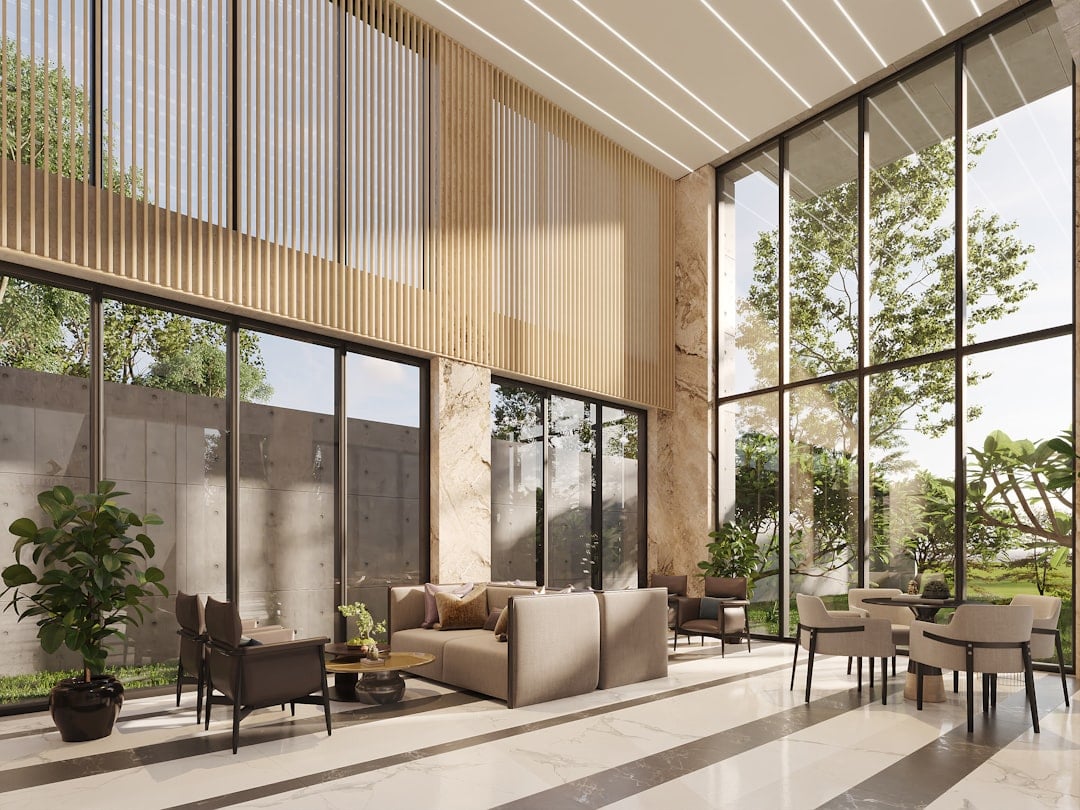
Wool, open-grained timber, linen, stone, woven fibres and patinated metal all respond differently to light and touch. Their surfaces vary. Some soften with age. Others pick up small changes in tone or wear.
Recent award-winning Australian architecture provides useful examples rather than proof of a national decorating rule. The Australian Institute of Architects’ 2025 National Architecture Awards included residential projects working with materials such as timber, bronze mesh, stone, brass, recycled elements and existing building fabric (Australian Institute of Architects, 2025).
Niwa House by John Ellway with Hannah Waring is particularly relevant. The Queensland alteration and addition reimagines a traditional Queenslander around a small courtyard. The jury described the courtyard as allowing “light, air and seasonal change to permeate” the house, while fine bronze mesh filters views and supports cross-ventilation, rain protection and insect control (Australian Institute of Architects, 2025).
What these projects demonstrate isn’t simply a preference for particular materials. They show how material, climate, light and use can be considered together.
That is a useful principle at room scale too. A dense wool rug beside timber. Linen against polished metal. An old table in an otherwise contemporary kitchen. Texture becomes most convincing when materials are allowed to differ rather than being coordinated into submission.
Climate Makes a Single “Australian Look” Unlikely
Australian interiors are often discussed as though the country shares one climate and one relationship with the outdoors. It doesn’t.
The Australian Government’s YourHome resource identifies eight main climate zones and stresses that different passive-design strategies suit different locations. Orientation, glazing, shading, insulation, thermal mass and ventilation need to work with local conditions rather than follow a universal formula (Department of Climate Change, Energy, the Environment and Water, n.d.).
On the Gold Coast, for example, shaded outdoor areas, operable openings and cross-ventilation may influence the way living spaces are planned. A house in a cool temperate region requires a different response.
Material choices can reinforce the relationship between interior and exterior, but “natural” doesn’t automatically mean climate-appropriate. Thermal performance, exposure, maintenance, durability and local conditions still matter.
Perhaps the more recognisably Australian quality isn’t a particular material palette at all, but an attention to how rooms relate to weather, landscape and movement between indoors and out.
Colour Is Becoming Less Prescriptive
The current colour conversation offers another clue.
Dulux’s 2026 Colour Forecast presents three palettes, Evoke, Elemental and Ethereal. Elemental centres on warm whites, browns, greys and grounded neutrals, while Evoke brings in earthy pinks, muted oranges, mustard-golds, grape, red, blue and deep aqua (Dulux, 2025).
More interesting than an individual paint shade is the thinking behind Evoke. Dulux describes it as rooted in vintage aesthetics, individual style and imperfection, with pieces from different periods brought together rather than matched precisely (Dulux, 2025).
As a commercial colour forecast, it should be read as an industry prediction rather than a survey proving how Australian households currently decorate. Still, it captures a useful shift in emphasis: personality over uniformity.
Dulux colour and communications manager Andrea Lucena-Orr has connected the forecast with digital overload, telling realestate.com.au that “Australians are feeling digitally overwhelmed” and pointing to a desire for greater emotional reconnection (Tilley, 2025).
For interiors, that can translate into rooms that don’t look newly assembled. A striped chair doesn’t need to repeat the colour of the rug. The lamp can come from a different decade than the table. A painting can simply be there because somebody liked it.
Existing Homes Are Being Treated as Material, Not Obstacles
The same willingness to work with what is already there appears in several of the 2025 National Architecture Award winners.
Carlton Cottage by Lovell Burton Architecture adapts a weathered Melbourne terrace through a central courtyard, new skillion roof, changing floor levels and material reuse. The original building isn’t erased to make the renovation legible (Australian Institute of Architects, 2025).
Gunn Ridge House by Kennedy Nolan takes a similarly measured approach to an existing Merchant Builders residence. Its original courtyard organisation, material restraint and passive-solar principles are retained while the house is adapted for another family (Australian Institute of Architects, 2025).
Both are exceptional architectural projects, not representative samples of Australian housing. But they illustrate an idea with much wider relevance: newness isn’t the only route to a considered interior.
The worn table may be exactly what a new kitchen needs. A chair can be reupholstered instead of replaced. Older timber, books, paintings and objects accumulated over time prevent a room from belonging entirely to one decorating cycle.
Liveable Rooms Leave Space for Change
A home rarely continues to serve exactly the same purpose it had when the furniture was first arranged.
Dining tables become workspaces. Spare bedrooms change use. A living room that is quiet on Tuesday may be crowded on Saturday night. Open-plan areas often have to support several activities at once.
That makes flexibility a useful design quality.
A rug can establish a sitting area without a wall. A floor lamp turns an unused corner into somewhere to read. An occasional chair can move when more people arrive. A console gives an entrance definition without building permanent joinery.
None of these ideas is new. Their value lies precisely in that ordinariness. A liveable room is often created through small adjustments rather than a dramatic redesign.
Conclusion
The relaxed, tactile Australian interior is better understood as a design direction than a universal change in household behaviour.
Its strongest expressions share a few ideas. Materials are allowed to have texture and age. Existing buildings and possessions are treated as resources. Climate matters. Colour can be personal rather than perfectly coordinated. Practicality is considered without allowing the room to become purely utilitarian.
The result isn’t an interior that has given up on beauty.
It is one with slightly different expectations of it.
A good room can take morning sun, dinner with friends, a dog crossing the floor and the inevitable movement of objects from one place to another. It can change over time without needing to be reinvented.
That may be the most appealing thing about this more relaxed approach: the room doesn’t need to look untouched to look considered.
References
Australian Bureau of Statistics. (2026, July 8). Building activity, Australia: March 2026. Australian Bureau of Statistics.
Australian Institute of Architects. (2025). 2025 National Architecture Awards: Winners. Australian Institute of Architects.
Department of Climate Change, Energy, the Environment and Water. (n.d.). Introduction: Passive design. YourHome.
Dulux. (2025). Dulux Colour Forecast 2026.
Tilley, E. (2025, August 28). Surprise home trend for 2026 you didn’t see coming. realestate.com.au.